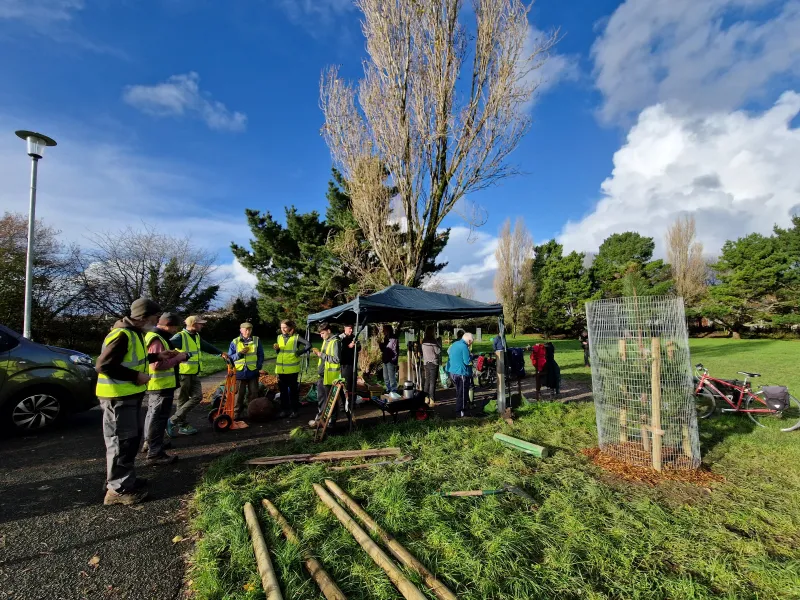
Plymouth Tree People depends on its volunteers, whether that means coming to an organised event to plant or care for trees, watering one or two new trees over summer or making a longer-term commitment to the trees in your area, there is something for everyone and you can do as much or as little as you like.
If you think you would like to give some time, we have opportunities which require no previous experience or you can contribute with particular skills or experience such as, more complicated tree care, web communications, funding applications, photography, helping with events, or administration, we would be pleased to hear from you.
Plymouth Tree People currently have over 50 registered volunteer Tree Wardens. Below are the kinds of things our Tree Wardens do.
The practical nature of Tree Wardening means that a few precautions are required which will be explained as part of a short induction. Plymouth’s Tree Warden volunteers are among thousands in local networks throughout the United Kingdom. The Tree Warden scheme is coordinated and supported nationally by The Tree Council.
You can find our Tree Warden Skills and Competency Framework here and our Tree Warden Professional Development guide here.
If you are interested in signing up as a volunteer Tree Warden, get in touch.
Aftercare Provider
What is involved?
Young trees require regular attention in order to establish and grow well. The tasks are quite simple and can be easily fitted in with other commitments. They include watering in summer, adjusting stakes and ties, and reporting any problems. The work is entirely practical and suitable for volunteers either working on their own or with others. Most Aftercare Providers are tending one or more trees near their home or place of work but some are happy to be considered for working anywhere as members of a mobile team. No previous tree-care experience is necessary.
Our mobile group meet every third Friday between September and March/April.
What’s in it for you?
- The opportunity to learn new tree-care skills.
- The opportunity to improve your knowledge of trees identification and of nature as a whole.
- Becoming part of a friendly, dedicated and passionate team.
- Meeting others with similar interests
- Improving safe-working knowledge and skills.
- An addition to your CV, especially if looking for new career openings.
Things that Aftercare Providers do:
- Carrying out a range of practical tree-care skills such as mulching, weeding, pruning, stake/tie maintenance and watering.
- Working with others as part of a team, or working alone or in pairs if preferred.
- Answering questions from passers-by (it’s O.K. to answer with “I don’t know.”)
- Reporting incidents or concerns about trees.
This role is voluntary and does not create a legally binding arrangement or employment contract.
Guided Walks Leader
What is involved?
Plymouth Tree People wants people to appreciate and enjoy the city’s trees. Guided walks in summer are one way to do that and to encourage more people to get active with trees.
Walks need to be planned well in advance and this can be done with volunteers who have led walks previously. They will explain what works best and how to deal with different situations. They will also help with preparing promotional materials and online booking. Guided walks can coincide with the Plymouth Urban Tree Festival, which we run in May.
What’s in it for you?
- The opportunity to lead a group on a walk and gain confidence. New leaders can be paired up with those who are more experienced to provide support.
- The opportunity to improve your knowledge of local trees and nature as a whole.
- Becoming part of a friendly, dedicated and passionate team.
- Meeting others with similar interests.
- There is support available to help you organise and publicise your event.
Things that Guided Walks Leaders do:
- Researching an area of interest and devising a suitable walk.
- Planning the event so that it is safe and enjoyable.
- Meeting attendees and making them feel welcome.
- Leading the walk so that it is interesting and informative.
This role is voluntary and does not create a legally binding arrangement or employment contract.
Orchard Keeper
What is involved?
Community orchards across the city require committed management to ensure their vitality.
They vary in size with some having just five trees and others having twenty five or more. They also vary in age with some newly planted and some considerably older. All are accessible to the public so Orchard Keepers will need to have a friendly manner and be ready to explain why their work is necessary. Once familiar with their orchard keepers will be trusted to carry out the right management actions across the seasons. The work is mainly practical and should be easily fitted in with other commitments. It is suitable for volunteers either working on their own or with a friend or relative, although other volunteers should be able to assist with big jobs like harvesting.
This role is suitable for people with previous fruit tree management experience.
What’s in it for you?
- Becoming part of a friendly, dedicated and passionate team.
- Meeting others with similar interests.
- Improving safe-working knowledge and skills.
Things that Orchard Keepers do:
- Carrying out a wide range of practical fruit tree-care skills e.g. watering, weeding, pruning and grafting.
- Harvesting the fruit.
- Answering questions from passers-by (it’s O.K. to answer with “I don’t know.”)
- Reporting incidents or concerns about the orchard.
This role is voluntary and does not create a legally binding arrangement or employment contract.
Projects Facilitator
What is involved?
Tree projects aim to improve a place by planting trees or carrying out tree-works. The aim is always “Right Tree, Right Place” which means choosing trees that will grow well in the particular location, help people relate to their surroundings in a positive way and not cause a nuisance in the future. Any project involves identifying and assessing different options before deciding on a course of action. Community projects must always have a large degree of consensus from local residents and the land owner, and a Projects Facilitator can help to achieve this by pointing out the pros and cons of different approaches. In agreeing a plan of action, the Facilitator can help to identify costs, look into ways of raising the necessary funding and make links with delivery partners.
What’s in it for you?
- The opportunity to guide schools, resident and community groups in choosing trees that will thrive and give them long-term pleasure.
- Improving your knowledge of trees and their attributes.
- Practising communication skills.
- Becoming part of a friendly, dedicated and passionate team.
- Meeting others with similar interests
Things that Projects Facilitators do:
- Responding to a request to advise about tree planting or related landscape changes.
- Understanding what objectives are wanted.
- Suggesting different options for meeting the objectives.
- Giving factual information for others to consider.
- Helping to build a consensus for a course of action.
- Opening lines of communication with project partners, including delivery partners.
This role is voluntary and does not create a legally binding arrangement or employment contract.
Researcher - Presenter
What is involved?
There are plenty of interesting stories about people, places and trees, some of which are well known but many of which are still to be discovered or presented in a new light. Delving into old records or asking local people about their memories can reveal fascinating facts which deserve to be presented so that others can appreciate them. Alternatively, why not share information about new tree related science or projects?
Much of the research effort has to be done individually, with volunteers free to choose their own lines of enquiry. The rewards come when finding out something new and sharing the results of research with others, whether it involves a social chat, an audience presentation or some kind of written work.
What’s in it for you?
- The opportunity to uncover local history and hear people’s memories or share new science or your research.
- The opportunity to practise presentation skills.
- The satisfaction of bringing more of the city’s heritage to light.
- Meeting others with similar interests
Things that Researcher - Presenters do:
- Identifying subjects where there might be a tree-interest angle.
- Visiting websites, libraries and the Record Centre to see what information is already known.
- Asking people who might have personal recollections for their inputs.
- Sharing information with others in the most suitable formats.
This role is voluntary and does not create a legally binding arrangement or employment contract.